Enables the extension of WinGuard with features, applications and integrations that solve individual requirements faster and independent of Advancis . Built by and for the Advancis Ecosystem.
Build, commission or integrate extensions and strengthen your position as a solution provider.
Customers
Solve unique requirements faster with a growing ecosystem, WinGuard stays at the center.
Developers
Turn project-specific work into reusable solutions and reach new customers through AOP.
Advancis Open Platform (AOP)
What AOP is
A secure and supported framework that enables new capabilities to be added to WinGuard without modifying the core product.
AOP is the open development framework that makes WinGuard extensible.
What you can build
From beginner to expert level: a few lines of JavaScript inside WinGuard, API Access, or a full extension running outside it.
Developers build their own WinGuard applications, functions and integrations, independently of Advancis.
What it changes
Project-specific needs are solved in the project. The standard product stays lean, stable and supportable.
Individual customer requirements get met far faster, without becoming a standard-product feature.
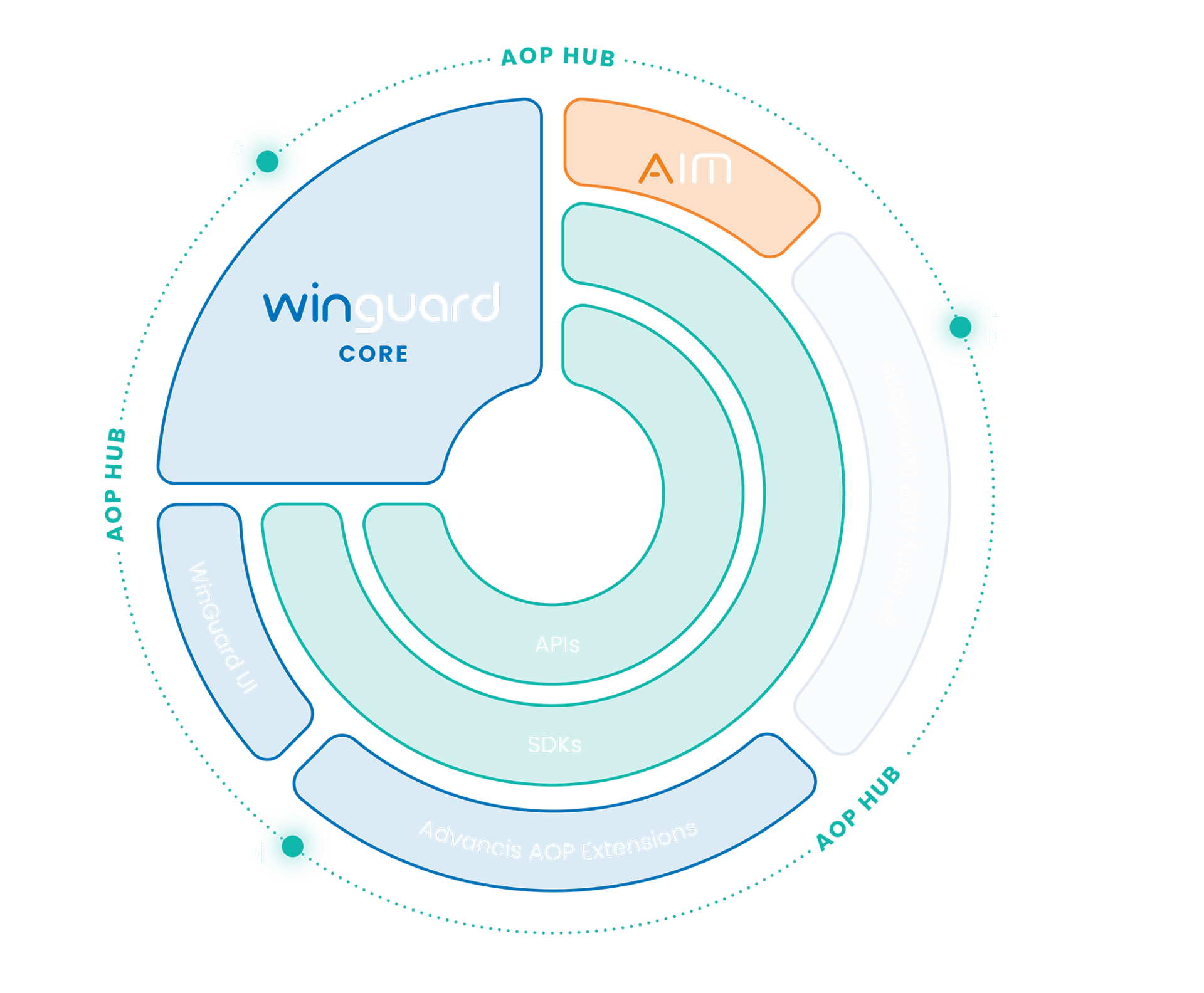
AOP provides the common foundation for WinGuard and every extension built around it. By exposing the same APIs, SDKs and platform services to everyone, solutions developed by Advancis, channel partners and third-party developers are built on the same architecture.
APIs, SDKs and platform services are the layer every extension talks to.
WinGuard Core and the WinGuard UI both sit on that same platform.
SDKs ship for C# and TypeScript are available already.
The AOP Hub rings the whole platform: where end users, channel partners and development partners meet.
New WinGuard modules for AOP
Three options, one framework.
Every AOP project starts with one of three choices. They share the same platform, the same data model and the same support. What differs is how far outside WinGuard your code runs, and how much it is allowed to do.
BAS
PRO
ENT
Scripting JavaScript
Automate workflows, actions and business logic directly within WinGuard. Scripting is the fastest way to implement project-specific requirements without deploying additional applications or services.
Read, write and control WinGuard objects
Automate event-driven workflows
Runs directly within WinGuard
PRO
ENT
API Access
Access WinGuard data and functionality through open APIs. Ideal for dashboards, analytics, AI services, web applications and connection with third-party services.
Connect applications and external services
Build dashboards and visualizations
Single connection to a WinGuard station
EXP
BAS
PRO
ENT
3rd-Party Extensions
Develop applications that extend WinGuard beyond standard capabilities. 3rd Party Extensions can solve specialized customer requirements, provide new integrations or evolve into reusable products distributed through the AOP ecosystem.
3rd party feature and adapter development
Deep integration with WinGuard workflows
Scalable for multiple customers and projects
Good to know
WinGuard's familiar customization options, including scripts, graphic editor and text editor, remain fully supported. AOP does not replace these capabilities. It expands them with professional development options for more advanced requirements.
Who writes the code
Development can be carried out by customers, channel partners or independent AOP developers. Advancis maintains the framework, while ownership of the resulting extension remains with its developer, enabling solutions to be enhanced, reused and commercialized across the ecosystem.
Scroll horizontally to compare →
What each of the three AOP development options supports
Use case
ScriptingJavaScript
API Access
3rd-Party Extension
Script or application runs outside of WinGuard
Not supported
Supported
Supported
Read, write and control data objects (locations, data points, …)
Supported
Supported
Supported
Event-driven automation
Supported
Supported
Supported
Dashboard (visualization)
Not supported
Supported
Supported
Monitored services and high availability (redundancy)
Not supported
Limited
Supported
Multiple connections (to WinGuard stations)
Not supported
Not supported
Supported
Adapter development possible
Not supported
Not supported
Supported
Generate events in WinGuard
Not supported
Not supported
Supported
Scope as of today. The complete API reference, SDK downloads and the developer program live in the AOP Hub.
WinGuard Licensing
ExpressBasicProfessionalEnterprise
API Access
Scripting (JavaScript)
WinGuard license for 3rd-Party Extension 13rd-Party Extension 1
WinGuard license for 3rd-Party Extension 23rd-Party Extension 2
WinGuard license for 3rd-Party Extension n3rd-Party Extension n
Search extension or developer…All developersAll typesAll statuses
14 extensions shown
AOPFeaturedAdapter
VAPIX
by Advancis Software & Services GmbH
Connects Axis network cameras and video encoders to WinGuard: live video, archive access, PTZ and camera events over the VAPIX API.
58 this season · 342 all-time
LegacyAdapter
ABI1500
by Advancis Software & Services GmbH
Connects the ABI1500 system to WinGuard.
66 this season · 512 all-time
AOPAdapter
ACSAPI
by Advancis Software & Services GmbH
Connects access control systems via the ACSAPI interface to WinGuard.
22 this season · 731 all-time
LegacyAdapter
AEOS
by Advancis Software & Services GmbH
Connects the Nedap AEOS access control system to WinGuard.
47 this season · 198 all-time
LegacyAdapter
AlphaCom
by Advancis Software & Services GmbH
Connects the Zenitel AlphaCom intercom system to WinGuard.
33 this season · 267 all-time
AOPAdapter
ARX
by Advancis Software & Services GmbH
Connects the ASSA ABLOY ARX access control system to WinGuard.
26 this season · 173 all-time
AOP Hub
Every extension. One hub.
The AOP Hub is the official home of everything that plugs into WinGuard: adapters and extensions from Advancis and from a growing ecosystem of developers. Browse what exists, compare it, and find the developer behind it.
Everything comes together through the channel partner.
The AOP ecosystem creates new possibilities. Channel partners turn them into customer solutions by combining WinGuard, extensions and specialized expertise into one integrated system.
Platform owner
Advancis
Builds and maintains WinGuard and AOP and runs the developer program.
WinGuard licenses for 3rd-Party Extensions
API Access
Scripting (JavaScript)
Integrates and delivers or hosts
Channel Partner
Holds the WinGuard license, builds extensions in-house, buys them from the hub, or commissions an AOP developer. Delivers the whole solution as one.
Advancis products
3rd-Party products
Uses WinGuard and AOP
End Customer
Receives one integrated system through their partner, and looks up in the hub what is available before asking for it.
Two-way between the AOP Hub and Advancis
AOP Developer Program
Two-way between the AOP Hub and the Channel Partner
The AOP Hub connects customers, channel partners and developers. Browse available extensions, discover development expertise and identify suitable solutions. Commercial agreements, service engagement and purchasing are handled directly with the respective provider.
Selected Advancis Extensions
Adapters developed by Advancis and made available through the AOP Hub with the consent of the respective technology partners.
Public AOP Developers
AOP developers available for customer and partner projects. Whether independent specialists, software vendors or channel partners, they provide the expertise required to turn requirements into working solutions.
Available 3rd-Party Extensions
Reusable applications, integrations and extensions developed by the AOP ecosystem and available for implementation through channel partners.
Become an AOP developer
Ready to build on WinGuard?
Join the partners worldwide developing on the Advancis Open Platform, and ship extensions that reach the most critical control rooms in the world.