






Opens in a new tab
Industry Solution

Transportation.

Keeping passengers, personnel, facilities, and transportation networks moving safely with WinGuard, the open integration platform for security and operational management.

The Challenge

Complex networks. Immediate response.

Transportation operators must protect passengers and personnel, prevent violence, vandalism, and property damage, and maintain reliable services across widely distributed infrastructure. Stations, depots, tunnels, offices, warehouses, and technical facilities rely on numerous security, communication, building, and information systems. When an emergency or technical fault occurs, control-room teams need a complete operational picture and the ability to coordinate the right response without delay.

  • Passenger and personnel safety

    Emergency calls and security incidents must be identified, located, and handled immediately.

  • Distributed infrastructure

    Central and local teams require consistent control across stations, depots, tunnels, and other facilities.

  • Operational continuity

    Technical failures must be detected and resolved quickly to minimize service disruptions.

  • Unified incident response

    Operators need prioritized information, guided procedures, and coordinated system actions.

The Platform

Everything at a glance.

WinGuard unifies video surveillance, personal emergency call and intercom systems, fire and intrusion detection, access control, perimeter protection, sprinkler systems, lighting control, weather sensors, and IT monitoring in one operational environment. Network structures, locations, and route sections can be mapped precisely so that alarms are displayed with the context teams need. Dynamic workflows guide operators through each event, while predefined cross-system actions and automated notifications support a fast, consistent response. Redundant and local server concepts help maintain availability across regional or nationwide infrastructures.

  • Vendor-neutral integrations
  • Prioritized alarms 
  • Scalable Architecture
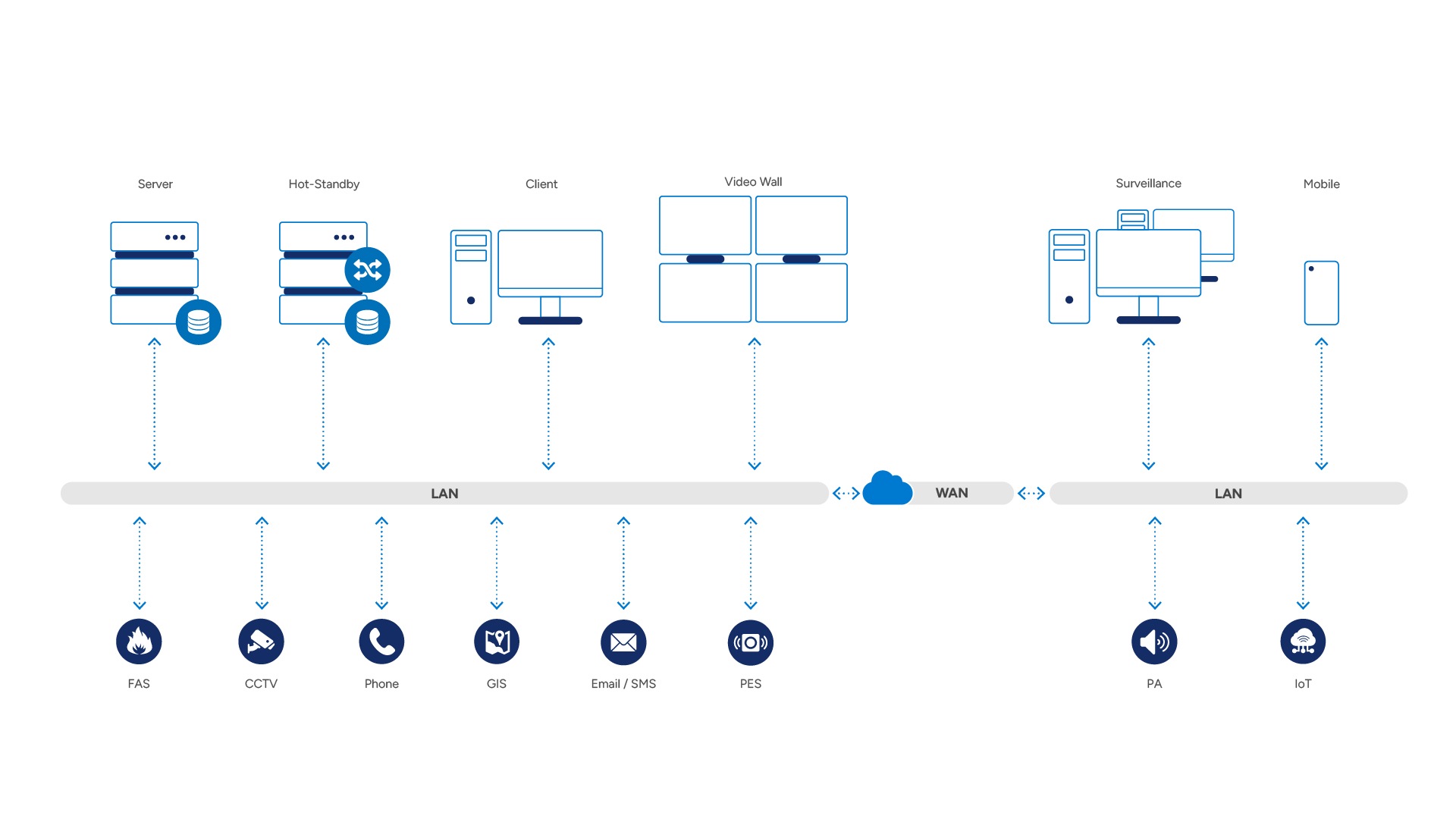
System architecture for energy operators: server, hot-standby, surveillance, client, video wall and mobile workstations connected over LAN; integrated subsystems include fire alarm (FAS), intrusion (IDS), CCTV, access control (AC), radio, public address (PA), perimeter and IoT
System architecture
Scenarios & Solutions

The situations WinGuard handles.

01 / 04

Responding to passenger and personnel emergencies.

Emergency calls from passengers or employees must reach the right team without delay. WinGuard prioritizes the event, identifies the affected location, and automatically displays available camera images and relevant system information.

Operators are guided through predefined procedures and can use connected communication systems to coordinate security personnel, emergency services, or local teams. Every action is documented for later review.

02 / 04

Managing incidents across stations, depots, and tunnels.

Fire alarms, intrusion events, and other security incidents may affect several systems and locations at once. WinGuard consolidates the incoming information and gives the control room a clear view of the situation.

Dynamic workflows support consistent decision-making, while connected systems can initiate coordinated actions such as displaying cameras, activating notifications, controlling lighting, or forwarding alarms to the responsible teams.

03 / 04

Detecting faults before they disrupt operations.

Transportation networks depend on the reliable operation of technical infrastructure. WinGuard monitors connected systems and can automatically create tickets in an internal fault-management system when a malfunction is detected.

Maintenance teams can be notified by email, text message, or telephone and review the current system status remotely. Local servers and redundant architectures help keep individual sites operational even when central connections are unavailable.

04 / 04
Companion use case

One identity. Consistent access across the network.

Large transportation organizations often manage access to stations, depots, control rooms, offices, warehouses, and technical areas through different local access-control systems. Frequent role, location, and contractor changes make it difficult to maintain a consistent overview of who can enter each sensitive area.

AIM centralizes cardholder and authorization management across the existing access-control landscape. It synchronizes identity and access data, supports the assignment and revocation of rights from a central point, and reduces duplicate manual updates. Security teams gain greater transparency while local infrastructure can remain in place.

Learn more about AIM