





Opens in a new tab
Industry Solution

Industry.

Protecting people, production, and complex industrial sites with WinGuard, the open integration platform for security and building operations.

The Challenge

Complex sites. Continuous production.

Industrial facilities combine extensive premises, production areas, offices, warehouses, and technical infrastructure. Fire detection, access control, video surveillance, building management, communication, and incident management systems must work together without interrupting production. Security teams need a clear operational picture, reliable guidance during emergencies, and complete documentation of alarms, malfunctions, maintenance activities, and every action taken.

  • Operational continuity

    Security incidents must be resolved quickly while production, logistics, and site operations continue safely.

  • Complex system landscapes

    Fire, security, building, communication, and incident management technologies must form one coordinated operational environment.

  • Fast, guided response

    Operators need clear location information, dynamic instructions, and automated cross-system actions when an event occurs.

  • Traceable processes

    Alarms, system states, revisions, and user actions must be documented for reporting, service control, and post-incident review.

The Platform

Everything at a glance.

WinGuard integrates industrial security, building management, communication, and incident management systems in one central operating interface. Operators can visualize alarms on site plans, control connected technologies, follow dynamic procedures, and initiate notifications or automated actions from a consistent environment. Redundancy concepts, protected event records, and comprehensive reporting support reliable operations across individual plants or distributed industrial sites.

  • Guided event processing
  • Protected documentation
  • Unified control
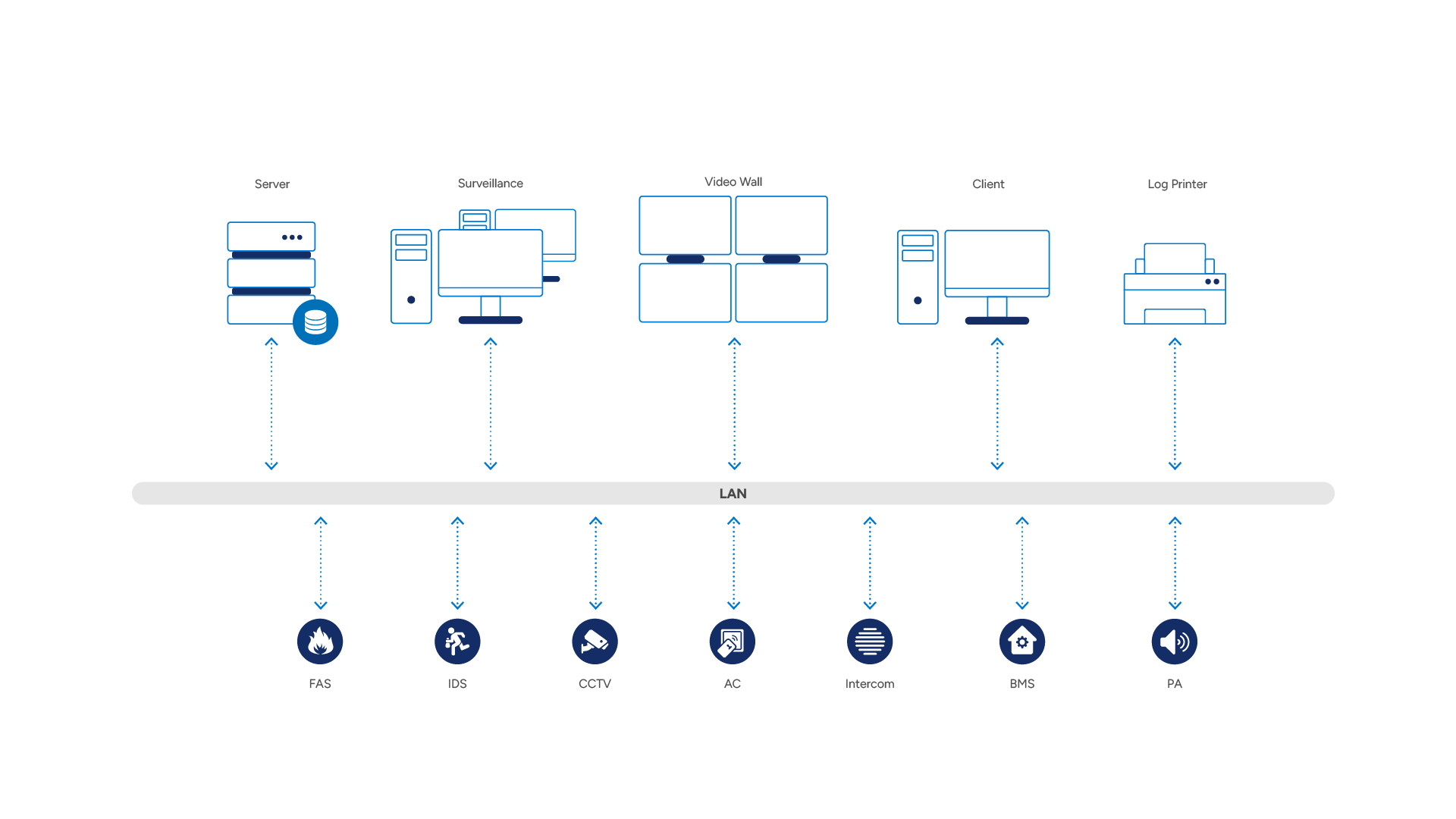
System architecture for energy operators: server, hot-standby, surveillance, client, video wall and mobile workstations connected over LAN; integrated subsystems include fire alarm (FAS), intrusion (IDS), CCTV, access control (AC), radio, public address (PA), perimeter and IoT
System architecture
Scenarios & Solutions

The situations WinGuard handles.

01 / 04

Coordinating a fire alarm without losing valuable time.

A fire alarm in a production or storage area requires an immediate and coordinated response. Operators must identify the exact detector location, understand the surrounding conditions, and initiate the correct measures while protecting employees and minimizing disruption to operations.

WinGuard displays the triggering detector on the relevant site or floor plan and guides the operator through the required response steps. In parallel, connected systems can initiate predefined actions and notifications through the available communication channels. Every manual and automated action is recorded for later evaluation and reporting.

02 / 04

Preventing unauthorized access across extensive industrial premises.

Large industrial sites include production areas, warehouses, technical rooms, offices, and external zones with different protection requirements. Unauthorized access must be detected and addressed quickly without interfering with authorized personnel or ongoing production.

WinGuard consolidates information from access control, video, intrusion detection, and other connected systems in one operational view. Operators can assess the location and context of an event, control relevant systems, and follow defined procedures. This supports a fast, consistent response across even widely distributed areas.

03 / 04

Keeping maintenance, revisions, and incident records under control.

Industrial security teams must manage not only emergency events but also malfunctions, detector disarmings, revisions, and recurring maintenance activities. Without a central record, it can be difficult to verify system states, coordinate service providers, and reconstruct actions after an incident.

WinGuard logs operator actions and automated processes in a protected event history. Situation-specific and scheduled reports support the evaluation of alarms, faults, disarmings, and revisions. Open interfaces can also connect higher-level incident management systems for deployment and resource planning.

04 / 04
Companion use case

Synchronizing workforce and contractor access across sites.

Industrial organizations manage employees, contractors, service providers, and visitors across locations with different access control systems and authorization structures. Manual updates during onboarding, role changes, temporary assignments, and departures can create duplicate work and leave outdated permissions in place.

AIM connects identity data and existing physical access control systems through one central management layer. Automated joiner, mover, and leaver processes help keep permissions aligned with current roles, while approval workflows support controlled access for contractors and external personnel. Centralized visibility and consistent updates reduce administrative effort and improve the enforcement of access policies without requiring immediate replacement of the existing access infrastructure.

Learn more about AIM